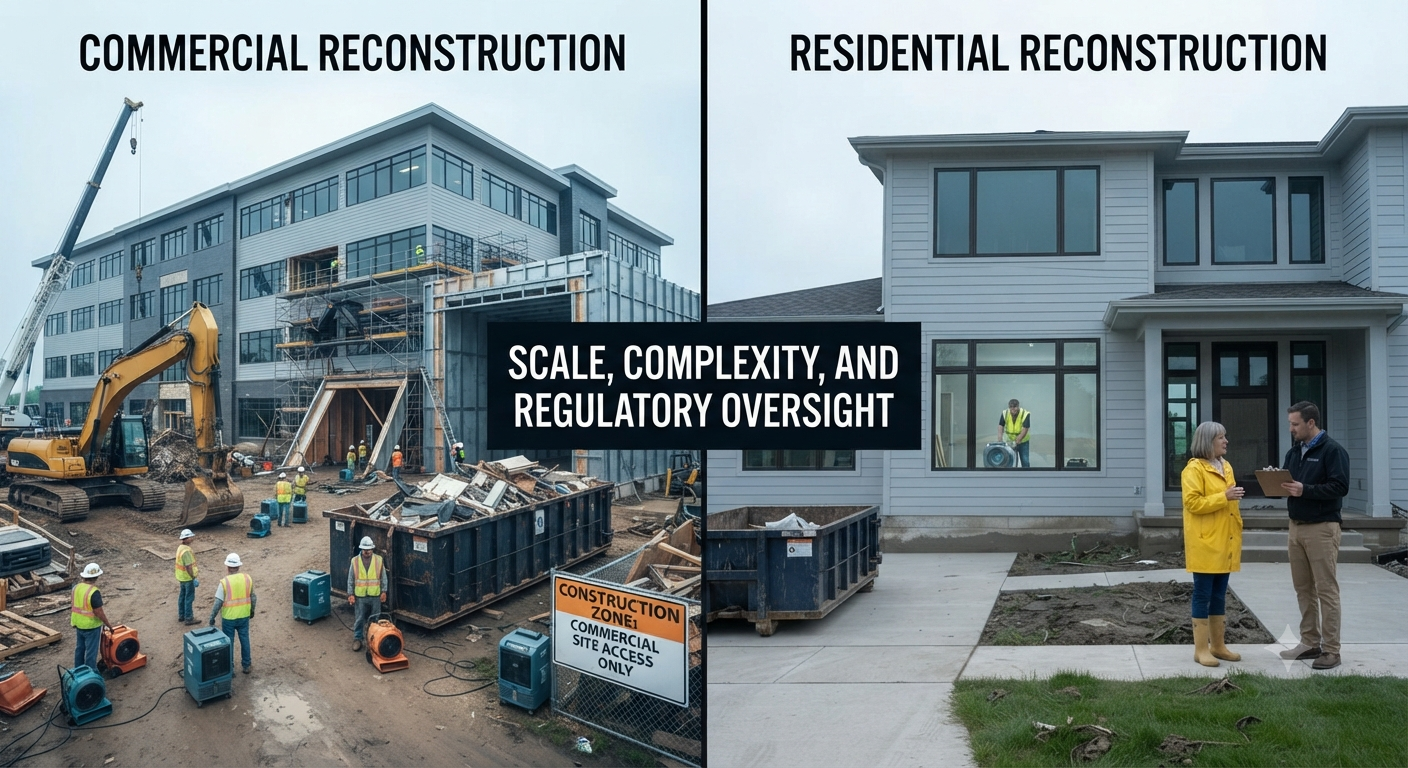
Commercial reconstruction after water or fire damage operates under constraints that residential restoration does not face: active business operations with revenue implications, multi-tenant environments with competing recovery timelines, building code requirements that differ from residential standards, and insurance documentation requirements that reflect the complexity of commercial policies. A residential rebuild can tolerate a four-week timeline. A commercial facility often cannot.
The Business Interruption Factor
Every day a commercial facility is non-operational is a day of lost revenue for the business and its tenants. Commercial restoration planning must account for the business interruption timeline as a primary variable alongside the structural reconstruction scope. This means prioritizing phases of the restoration that enable partial operations, sequencing work to clear critical spaces first, and managing the construction timeline against the insurance carrier’s business interruption coverage period.
Business interruption coverage under most commercial policies pays for lost revenue during the period of restoration that is directly attributable to the covered damage event. The restoration company’s timeline documentation directly affects how much of this coverage the business can claim. AGI’s commercial construction team prepares timeline documentation that supports business interruption claims alongside the structural restoration scope.
Multi-Tenant Coordination Complexity
Commercial buildings with multiple tenants present coordination challenges that single-occupancy properties do not. A water loss originating in one tenant’s space may affect systems shared with adjacent tenants. Reconstruction access requires coordination with tenants who have their own operational schedules and who may have independent insurance claims for their damaged fit-out and contents.
Disputes about shared system damage, responsibility allocation between building owner and tenant policies, and scheduling that accommodates multiple occupancies all require management that goes beyond the construction work itself. Restoration companies with commercial experience have established processes for these coordination requirements. Those without it create conflicts that delay the reconstruction and damage tenant relationships.
Code Compliance in Commercial Reconstruction
Commercial buildings are subject to local building codes that may require upgrades when reconstruction exceeds certain thresholds of scope or value. ADA accessibility requirements, fire suppression system changes, electrical panel upgrades, and HVAC equipment standards can all be triggered by reconstruction work that would have no equivalent requirement in a residential rebuild.
AGI’s specialty services include coordination with local building departments for permit applications, code compliance review, and inspection scheduling. Commercial reconstruction that proceeds without proper permitting creates liability for the property owner that surfaces during future property transactions, refinancing, or subsequent insurance claims where the unpermitted work is discovered.
The Water Damage to Mold Timeline in Commercial Settings
Commercial properties face the same 24 to 48 hour mold growth window as residential properties, but the consequences of mold development in a commercial setting are amplified by employee health and liability considerations. An employer who returns workers to a facility with unaddressed mold contamination from a water damage event faces potential occupational health liability that extends well beyond the property damage claim. AGI integrates water damage restoration and mold remediation as connected services in commercial restoration scopes, assessing mold risk from the first day and adjusting the restoration sequence if delayed response has already created growth conditions.
Documentation for Commercial Insurance Claims
Commercial property insurance policies document damage and restoration through formats that differ from residential policies. Commercial adjusters require line-item restoration estimates organized by trade, building systems documentation that identifies affected mechanical and electrical components by specification, and timeline documentation that connects each phase of the restoration to the business interruption period.
The documentation package for a commercial restoration claim also needs to distinguish between the building owner’s policy coverage and any tenant improvement coverage that the tenants’ own policies may address separately. AGI’s catastrophe response experience with large-scale commercial losses means these documentation requirements are built into the restoration scope from the start, not assembled after the fact when adjusters request information the restoration team has to reconstruct from records.
When to Involve the Restoration Company Before the Claim
Commercial property managers who establish relationships with restoration companies before a loss occurs are better positioned than those who search for a vendor in the aftermath. Pre-loss planning identifies preferred vendors, establishes protocols for emergency response, and gives the restoration team prior knowledge of the building’s systems that accelerates assessment when an event occurs.
Frequently Asked Questions
Q: How is commercial restoration different from residential restoration?
A: Commercial restoration involves business interruption considerations that residential projects do not, multi-tenant coordination in shared buildings, commercial building code requirements that may trigger upgrades during reconstruction, and insurance documentation formats specific to commercial policies. The restoration timeline must account for operational impacts on businesses and tenants, and the documentation must support business interruption claims alongside the structural scope.
Q: Does commercial insurance cover water and fire damage restoration?
A: Standard commercial property policies cover fire and water damage restoration from covered events. Commercial policies also typically include business interruption coverage that pays for lost revenue during the restoration period. The specific coverage terms, deductible amounts, and business interruption waiting periods vary significantly between policies. Working with a restoration company that handles commercial insurance documentation ensures the claim is presented in the format commercial adjusters require.
Q: How quickly can a commercial facility return to operations after a water loss?
A: Timeline depends on the scope of structural damage, the systems affected, and local permit requirements for the reconstruction. Emergency mitigation including extraction and drying typically begins within hours of the call and runs three to five days. Reconstruction following clearance can take weeks to months depending on scope. An experienced commercial restoration company sequences work to enable partial operations as soon as safely possible while full reconstruction proceeds in non-critical areas.
Q: What is pre-loss planning for commercial properties?
A: Pre-loss planning is the process of establishing emergency response protocols, identifying preferred restoration vendors, and documenting building system information before a loss occurs. Property managers who complete pre-loss planning respond faster when an event occurs because vendor relationships, access protocols, and documentation systems are already in place. Many commercial restoration companies offer pre-loss planning services as part of their ongoing client relationship.
Commercial property damaged by water or fire? AGI handles commercial restoration with business interruption documentation, multi-tenant coordination, and code compliance expertise. Call now.